

Last Update :
|
|
|
Last Update : Today : |
|
|

 |
 |
|
Peugeot has had a dramatic, but highly successful five seasons
since it introduced its multi-title winning 206 WRC onto the
World Rally Championship stage in 1999, but in that time the
French equipe has made an indelible mark on the sport's top
level. It has adopted a highly-focused approach to its most
recent stint in rallying, and realised the potential of the
small, but nimble 206 with a string of manufacturers' titles
and two drivers' championship for stunningly talented Finn Marcus
Gronholm.
Peugeot had previously been successful at rallying's top level in the mid 1980s when its 205 Turbo 16 was arguably the leading Group B car. The mid-engined, 550bhp pocket rocket won titles in 1985 and 1986, but, when the class was outlawed, Peugeot didn't have a replacement and moved to desert rally raids, sportscars and Formula 1 with varying degrees of success. In 1996, however, the seeds of a WRC return were sown as Peugeot developed the 306 Maxi kit car and claimed the French title with Gilles Panizzi. Another French title for the rapid Frenchman followed in 1997, but in 1998 development switched to the four-wheel-drive 206 WRC. It made its debut in Corsica in 1999 and led after just two stages. Although fast, it was prone to mechanical niggles and failed to win in its first year. In 2000, however, the combination of Panizzi, Francois Delecour and Marcus Gronholm was enough to win the manufacturers' title in only the second year for the 206, while Gronholm lifted the drivers' crown despite not having a full-season deal. Peugeot's title defence didn't get off to a solid start, and it proved to be a win or bust 2001 season for the Gronholm, Panizzi and new recruit Harri Rovanpera, which meant Peugeot retained its manufacturers' title, but lost out in the drivers' race to Subaru's Richard Burns. In 2002, though, Gronholm had a vintage year with five wins to take his second title, while Panizzi won three times and dramatic joinee Richard Burns was a consistent points scorer to help Peugeot to a third manufacturers' crown in a row. The lack of reliability returned for 2003, meaning that Gronholm suffered the ignominy of battling a troublesome car once again, but Burns made the best of a bad situation and focused on finishing events to remain in contention to the end of the year. It was clear the 206 had reached the end of its potential, and Peugeot rushed to introduce the 307 coupe for 2004. Early season teething troubles frustrated Gronholm once again, but the car's potential gradually became clear before success in Finland. With Markko Martin also on board the driving force, things should be even better in 2004. Prospects for 2004
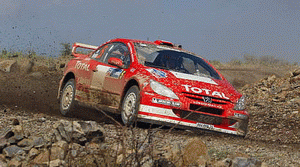
Peugeot starts the season with a brand new car, the 307 WRC,
based on a coupe cabriolet! It has a completely different philosophy
to the 206, but Peugeot's engineers are convinced that it is
the way forward. They don't normally do anything by halves or
spare any expense, so their new challenger has every chance
of World Rally Championship success.
2003
After a dominant 2002, everybody expected Peugeot to clean up again
last year – but nothing could be further from the truth. A mixture
of chronic unreliability and bad luck resulted in a disappointing
season - although Richard Burns' consistency ensured he remained
a title contender. There were still flashes of the usual Marcus
Gronholm brilliance, such as his win from the back in Argentina,
but equally he made an extraordinary number of amateur mistakes
that cost him any chance of the title. The car itself wasn't too
bad, but it was simply overtaken by newer and faster opposition.
Even asphalt ace Gilles Panizzi struggled on rallies where he is
usually dominant.
2002
A vintage year for Peugeot. Marcus Gronholm won five times to take his second drivers' championship; Gilles Panizzi won three times to tighten his grip on the tarmac-meister trophy and Peugeot scored a maximum 16 points on nine occasions to take yet another manufacturers' crown. Defending champion Richard Burns may not have won, but showed in Finland and New Zealand that he has the speed to beat Gronholm. Peugeot also nailed its Achilles heel, reliability on rough events, with a win in Cyprus. As a result, tobacco brand Marlboro left Mitsubishi and joined the French champions for 2003.
2001
The team's defence of its title didn't get off to the best of starts with all three of its drivers out on the first day of competition in Monte Carlo. Things improved on Rally Sweden, when emerging star Harri Rovanpera scored his debut victory. However the team hadn't nominated the Finn to score points in Sweden, so didn't score until Portugal. However when the team did score, it tended to score heavily, with maximum points taken from Spain, Italy, Corsica and wrapping up the manufacturers' title with another one-two on Rally GB.
2000
The combination of Marcus Gronholm, Francois Delecour and Gilles Panizzi was good enough to lift both the drivers' and manufacturers' crowns, even if there was more than a little friction between the two French drivers. Gronholm was a potent force on almost any surface, while Delecour and Panizzi scored vital one-twos in the asphalt rounds towards the end of the year, Corsica and Sanremo.
1999
The 206 WRC made its first appearance in Corsica (historically an important rally for a French marque) and it led after just two stages. But, while the car was fast throughout its limited programme, it was still prone to mechanical niggles and it failed to win a rally. It came closest to achieving that goal in Sanremo, where both Francois Delecour and Gilles Panizzi led during the last day, only to be denied by Tommi Makinen.
1998
The World Rally Car project was now in full swing, as Peugeot began to shift its focus away from Formula 1. Accordingly, it only entered Francois Delecour and Gilles Panizzi on a handful of asphalt rallies in the 306 Maxi. Development on the two-wheel drive, normally aspirated car had virtually stopped by this point, but it was still quick enough to claim Formula 2 category wins in Corsica, Monte Carlo and San Remo.
1997
Peugeot was seriously considering moving to four-wheel drive but, in the meantime, it focused on the French domestic scene (reaping a national title for Gilles Panizzi) and a limited WRC campaign. In the hands of Panizzi and Francois Delecour, the lightweight 306 Maxi was quick enough on the asphalt of Catalunya and Corsica to net wins in Formula 2.
1996
Switching from the 'ordinary' 306 S16 to the stunning, 306 Maxi kit car proved a good move for Peugeot, which claimed the French crown thanks to Gilles Panizzi. But the two-wheel drive car was never a likely prospect for the WRC and it appeared only twice. At least Francois Delecour clinched Formula 2 honours with the car in Monte Carlo.
Pre 1996
Peugeot's rallying hey-day was the mid-1980s, when its 205 Turbo 16 was arguably the top Group B car. The mid-engined, 550bhp pocket rocket won world titles in 1985 and 1986, but, when the category was outlawed, Peugeot didn't have a suitable car to continue in the WRC and it moved to desert rally raids, dirt hillclimbs, sportscars and Formula 1.
|
TEAM PRINCIPAL: Corrado Provera
DRIVERS: Marcus Gronholm - Markko Martin CAR: 307 WRC
BASED: Velizy, France
ESTABLISHED: 1982 FIRST WRC WIN: 1984 TEAM HIGHLIGHTS 2004: Peugeot introduces the 307, but reliability woes limit Marcus Gronholm to one win in Finland 2003: Three early wins for Marcus Gronholm fail to give him a third drivers' crown, while Gilles Panizzi wins in just Spain. Richard Burns, however, stays in the title fight to the end despite no wins 2002: Marcus Gronholm wins five times to lift his second drivers' crown, while Gilles Panizzi wins three times to ensure Peugeot takes a third manufacturers' title 2001: Peugeot takes the manufacturers' title again, but Marcus Gronholm struggles in the drivers' fight with three wins, while Gilles Panizzi and Harri Rovanpera score one each 2000: Marcus Gronholm takes the drivers' title with four wins, while two wins for Gilles Panizzi help the Peugeot team to take the manufacturers' title 1999: Peugeot returns to the WRC's top level with the 206 in Corsica
|


